
Spiritual Beings
On last week’s podcast, Bryan and I went right to the same story when we thought about the world beyond our sight. Maybe it’s what you think of too? It’s that moment when Elisha prays from the wall of Jerusalem, that God would open his servant’s eyes to see that “those who are with us are more” than those with the enemy. And he saw that “the mountain was full of horses and chariots of fire” (2 Kings 6:16-17).
We get glimpses of that world beyond our sight, too, by reading Scripture. But sorting out the Bible’s language for spiritual beings can be a lot. We did a little brainstorm in the podcast of Bible terminology and still barely scratched the surface. There’s angels, of course. Then there are Cherubim and seraphim. The heavenly host, Sons of God, the Divine Council. Daniel talks about watchers and princes. Paul talks about rulers and authorities in the heavenly places. Then there are demons, unclean spirits, fallen angels, and Satan.
Are all of these different kinds of beings? Are some different names for the same beings? There isn’t one passage that explains how they all fit together and we have to accept the limits of God’s revelation. But we can have confidence in what he does want us to know (Deut. 29:29) and shouldn’t be afraid to study and embrace these truths.
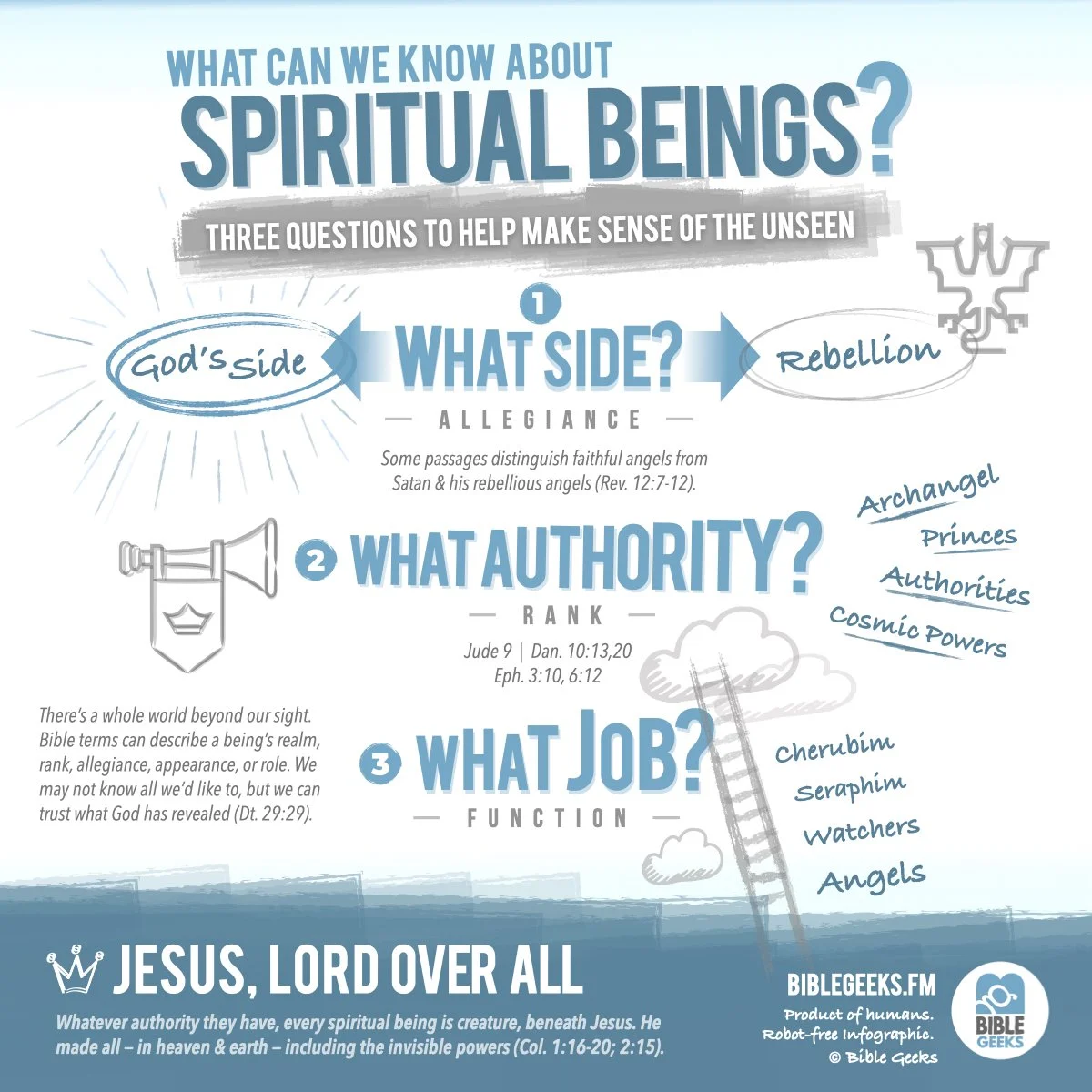
So instead of trying to construct an “org chart” the Bible never gives us, here are three questions that can help us sort through what it does reveal, as we notice the meaning and context of the Bible’s words:
ALLEGIANCE: Whose side are they on?
POWER: What authority do they have?
FUNCTION: What do they do?
Those questions won’t answer everything. But they can help us make sense of a spiritual realm that is bigger and more important in the Bible’s story than we might imagine.
ALLEGIANCE: Whose side are they on?
The most important distinction between spiritual beings is, “Who do they serve?“ God has a host of heavenly servants, “*mighty ones who do his word*” (Ps. 103:20).
But we also read of angels who abandoned their proper place (2 Peter 2:4; Jude 6). Satan, the adversary, has “his angels” who fought against “Michael and his angels” and were defeated (Rev. 12:7-9). Paul says we battle with “the devil” and the “the cosmic powers over this present darkness … spiritual forces of evil in the heavenly places” (Eph. 6:12). The gospels are full of “demons” or “unclean spirits” who recognized Jesus with fear (Mark 5:7) and came out at his command (Luke 4:36). His casting out demons declared the coming of the kingdom (Matt. 12:28, see Zach. 13:1).
So our first question opens our eyes to a spiritual world split by conflict, where free-will agents can either serve God or rebel. Humans aren’t the only ones who have fallen. And Christ’s victory over sin and death must also disarm these powers (Col. 2:14-15; Heb. 2:14-15) and reconcile everything, “whether on earth or in heaven,” to God (Col. 2:16,20).
POWER: What authority do they have?
Some of the Bible’s terms show us different ranks among spiritual beings. Michael is an obvious example. Daniel calls him “one of the chief princes,” “your prince,” and “the great prince” (Dan. 10:13,21; 12:1). And then Jude 9 calls him “the archangel.” Paul also speaks of rulers, authorities, powers, dominions, and thrones (Rom. 8:38; 1 Cor. 15:24; Eph. 1:20–21; 3:10; 6:12; Col. 1:16).
We don’t know a hierarchy of how they all relate to each other, but the fact that some of these terms describe levels of authority opens our eyes to that aspect of the spiritual realm.
And it connects to an even more important truth: “For by him all things were created, in heaven and on earth, visible and invisible, whether thrones or dominions or rulers or authorities — all things were created through him and for him” (Col. 1:16).
Whatever authority any spiritual being possesses, every authority (visible and invisible!) is beneath Jesus Christ.
FUNCTION: What do they do?
Both the Hebrew and Greek (Old and New Testament words) usually translated “angel” mean “messenger.” That tells us something about their job description! They often seem to go back and forth from God’s presence (see Gen. 28:12; Job 2:1), carrying God’s words and will (for example, Luke 1:5-38). They’re also described as “ministering spirits sent out to serve for the sake of those who are to inherit salvation” (Heb. 1:14).
A less common term, watcher, is another functional description. It describes “a watcher, a holy one” that came down from heaven to announce God’s judgment (Dan. 4:13, 17, 23). The Bible also talks about cherubim (Gen. 3:24; Exod. 25:18-22; Ps. 80:1; 99:1; Ezek. 1, 10), seraphim, and the “four living creatures” around God’s throne (Rev. 4:6–8). These beings often show up in visions with astonishing descriptions, but the main idea seems to be their function as guardians and worshipers before the Lord.
And Above Them All…
So we take what the Bible gives us and often these texts answer one of these questions. But the point of studying the spiritual realm isn’t to become fascinated with angels or frightened by demons. Most of all, it’s to understand how they fit into God’s plan to save us in Christ. God raised Jesus from the dead and seated him “far above all rule and authority and power and dominion” (Eph. 1:21). The risen Jesus “has gone into heaven and is at the right hand of God, with angels, authorities, and powers having been subjected to him” (1 Pet. 3:22). Jesus is Lord of all creation, what we see and what we don’t!